
101 · Question #206
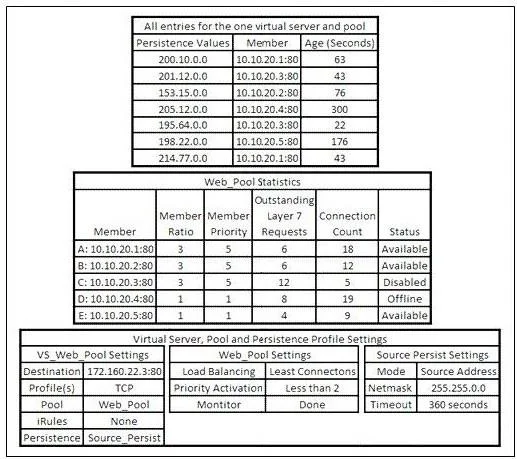
A virtual server is defined using a sourceaddress based persistence profile. The last five connections were A, B, C, A, C . Given the conditions shown in the graphic, if a client with IP address…
The correct answer is B. 10.10.20.2:80. With source address persistence, a new client IP with no existing persistence record is load-balanced normally; based on round-robin rotation after five prior connections (A, B, C, A, C), the next new connection is directed to member B.
Question
A virtual server is defined using a sourceaddress based persistence profile. The last five connections were A, B, C, A, C . Given the conditions shown in the graphic, if a client with IP address 205.12.45.52 opens a connection to the virtual server, which member will be used for the connection.
Exhibit
Options
- A10.10.20.1:80
- B10.10.20.2:80
- C10.10.20.3:80
- D10.10.20.4:80
- E10.10.20.5:80
How the community answered
(17 responses)- B59% (10)
- C12% (2)
- D6% (1)
- E24% (4)
Why each option
With source address persistence, a new client IP with no existing persistence record is load-balanced normally; based on round-robin rotation after five prior connections (A, B, C, A, C), the next new connection is directed to member B.
Member A (10.10.20.1:80) has already received two connections in the current sequence and is not the next in the round-robin rotation for a new client.
Source address persistence maps a client IP to a specific pool member only after that IP has been seen before. Since 205.12.45.52 has no persistence record, round-robin load balancing applies, and after the sequence A, B, C, A, C the next round-robin slot resolves to member B (10.10.20.2:80).
Member C (10.10.20.3:80) has also received two connections and is not next in the round-robin order for an unrecognized source IP.
Member D (10.10.20.4:80) has received zero connections but the round-robin pointer has not advanced to this member yet given the current connection history.
Member E (10.10.20.5:80) has received zero connections but is further along in the round-robin sequence than member B given the current state of the load balancing algorithm.
Concept tested: Source address persistence and round-robin load balancing interaction
Source: https://techdocs.f5.com/en-us/bigip-17-1-0/big-ip-local-traffic-management-implementations/configuring-source-address-affinity-persistence.html
Topics
Community Discussion
No community discussion yet for this question.