
101 · Question #193
The incoming client IP address is 205.12.45.52. The last five connections have been sent to members C, D, A, B, B. The incoming client. IP address is 205.12.45.52. The last five connections have…
The correct answer is A. 10.10.20.1:80. This question tests how the Least Connections load balancing method selects the next pool member based on active connection statistics shown in the graphic.
Question
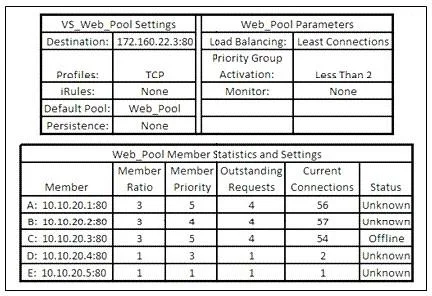
The incoming client IP address is 205.12.45.52. The last five connections have been sent to members C, D, A, B, B. The incoming client. IP address is 205.12.45.52. The last five connections have been sent to members C, D, A, B, B. Given the virtual server and pool definitions and the statistics shown in the graphic, which member will be used for the next connection.
Exhibit
Options
- A10.10.20.1:80
- B10.10.20.2:80
- C10.10.20.3:80
- D10.10.20.4:80
- E10.10.20.5:80
How the community answered
(60 responses)- A60% (36)
- B7% (4)
- C2% (1)
- D23% (14)
- E8% (5)
Why each option
This question tests how the Least Connections load balancing method selects the next pool member based on active connection statistics shown in the graphic.
Based on the pool statistics shown in the graphic, member 10.10.20.1:80 currently has the fewest active connections among all pool members. The Least Connections method always forwards the next new request to the member with the lowest active connection count at that moment. The prior connection history (C, D, A, B, B) reflects earlier selections, but the current snapshot of active connections is what determines the next choice.
10.10.20.2:80 has more active connections than member A at this point in time, so the Least Connections algorithm will not select it next.
10.10.20.3:80 currently holds more active connections than member A and is therefore not the least-loaded member.
10.10.20.4:80 has a higher active connection count than member A and is not selected.
10.10.20.5:80 also has more active connections than member A and is bypassed by the algorithm.
Concept tested: F5 BIG-IP Least Connections load balancing selection
Source: https://techdocs.f5.com/en-us/bigip-15-1-0/big-ip-local-traffic-management-load-balancing-methods.html
Topics
Community Discussion
No community discussion yet for this question.