
101 · Question #17
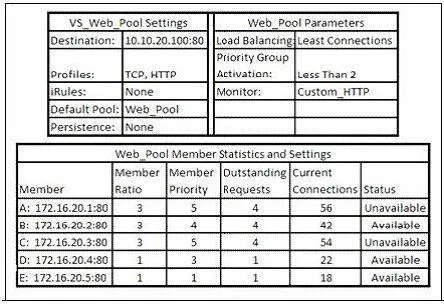
A virtual server is defined per the charts. The last five client connections were to members C, D, A, B, B . Given the conditions shown in the above graphic, if a client with IP address 205.12.45.52…
The correct answer is D. 172.16.20.4:80. This question tests knowledge of F5 BIG-IP pool load balancing and connection routing based on a member rotation sequence defined by the pool's configured method.
Question
A virtual server is defined per the charts. The last five client connections were to members C, D, A, B, B . Given the conditions shown in the above graphic, if a client with IP address 205.12.45.52 opens a connection to the virtual server, which member will be used for the connection.
Exhibit
Options
- A172.16.20.1:80
- B172.16.20.2:80
- C172.16.20.3:80
- D172.16.20.4:80
- E172.16.20.5:80
How the community answered
(26 responses)- A12% (3)
- B4% (1)
- C4% (1)
- D81% (21)
Why each option
This question tests knowledge of F5 BIG-IP pool load balancing and connection routing based on a member rotation sequence defined by the pool's configured method.
Member A (172.16.20.1:80) was used two rotations ago and does not appear next in the current active member sequence.
Member B (172.16.20.2:80) already received the last two consecutive connections and would not be selected again before other eligible members are used.
Member C (172.16.20.3:80) was used earlier in the sequence and is not the next member due in the active rotation.
Based on the pool configuration shown in the graphic (likely Round Robin with member E marked unavailable or disabled), after the five connections to C, D, A, B, B, the active rotation cycles back to D (172.16.20.4:80) as the next eligible member. The repeated connection to B indicates E was skipped due to being unavailable, and the resulting effective rotation of the four active members places D next in sequence.
Member E (172.16.20.5:80) is likely disabled or marked down per the graphic, which is why B received two consecutive connections instead of E receiving one.
Concept tested: F5 BIG-IP pool member load balancing rotation
Source: https://techdocs.f5.com/en-us/bigip-16-1-0/big-ip-local-traffic-management-getting-started-with-local-traffic-management/big-ip-local-traffic-management-getting-started-with-local-traffic-management/load-balancing-decisions.html
Topics
Community Discussion
No community discussion yet for this question.