nerdexam
IBM

000-221 · Question #60

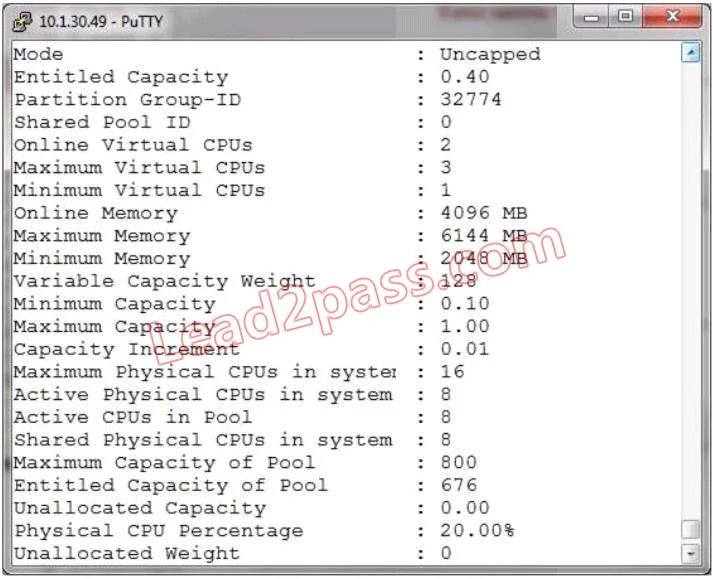
Given the this output of the Iparstat -i' command from an LPAR, which statement is true?

The correct answer is E. The LPAR can utilize processing capacity from any of the active CPUs. The lparstat -i output showing shared processor pool membership means the LPAR can draw processing capacity from any active CPU in the shared pool. This reflects IBM PowerVM shared processor pool behavior.

Performance Monitoring and Tuning

Question

Given the this output of the Iparstat -i' command from an LPAR, which statement is true?

Exhibit
000-221 question #60 exhibit

Options

  • AThere are 8 physical CPUs installed configured into 2 processor pools.
  • BAll active CPUs are dedicated to this LPAR.
  • CThere are 8 active CPUs available for sharing and another 8 active for dedicated use
  • DThe LPAR can automatically use up to 8 physical CPUs.
  • EThe LPAR can utilize processing capacity from any of the active CPUs.

How the community answered

(27 responses)
  • A
    4% (1)
  • C
    11% (3)
  • D
    7% (2)
  • E
    78% (21)

Why each option

The `lparstat -i` output showing shared processor pool membership means the LPAR can draw processing capacity from any active CPU in the shared pool. This reflects IBM PowerVM shared processor pool behavior.

AThere are 8 physical CPUs installed configured into 2 processor pools.

The lparstat output does not indicate two separate processor pools; a single shared pool is in use, not a split between two pools.

BAll active CPUs are dedicated to this LPAR.

Dedicated CPU mode would show all CPUs exclusively assigned to this LPAR, but the output reflects shared mode where CPUs are distributed among multiple LPARs.

CThere are 8 active CPUs available for sharing and another 8 active for dedicated use

The output does not reflect a split configuration of 8 shared and 8 dedicated CPUs; that would require two separate pool entries.

DThe LPAR can automatically use up to 8 physical CPUs.

The LPAR using up to 8 physical CPUs describes a capped or entitled capacity limit, not unrestricted access - the correct interpretation is pool-wide availability rather than a hard maximum cap.

EThe LPAR can utilize processing capacity from any of the active CPUs.Correct

When an LPAR is configured to use a shared processor pool, its virtual CPUs are not pinned to specific physical CPUs. Instead, the hypervisor (PowerVM) can schedule the LPAR's workload on any active physical CPU within the shared pool, allowing it to utilize processing capacity from any of those CPUs dynamically.

Concept tested: IBM PowerVM shared processor pool LPAR scheduling

Source: https://www.ibm.com/docs/en/aix/7.3?topic=l-lparstat-command

Topics

#lparstat#shared processor pool#CPU sharing#LPAR configuration

Community Discussion

No community discussion yet for this question.

Full 000-221 Practice